
Re-imagining English with Inquiry in Mind
Alternatives to content-driven units in junior secondary English

I came across the graphic below (scroll down) in my archives this week, from a version of MTeach junior English I taught in 2020-2021. It was EUN121 in 2020 and the unit outline included teaching inquiry approaches in English.
What do I mean by ‘inquiry learning’?
Most of the other subjects already had a framework for inquiry. Science inquiry in science, historical inquiry and geographic inquiry in HASS. Problem based learning and mathematical modelling in maths. Praxis in the Arts.
But English is still playing catch up when it comes to having an inquiry approach of our own.
My in-a-nutshell, very best explainer for inquiry learning, one I share with students all the time, is in a blog post written by my former colleague Mandy Lupton:
https://inquirylearningblog.wordpress.com/2012/08/22/what-is-inquiry-learning/
Lupton explains that inquiry learning includes three elements:
1) questioning frameworks
2) information literacy / information seeking process
3) an action research cycle
To help pre-service teachers imagine the array of inquiries this could look like in English, I imagined an entire junior English program that used different questioning frameworks and a variety of inquiry pedagogies/cycles:
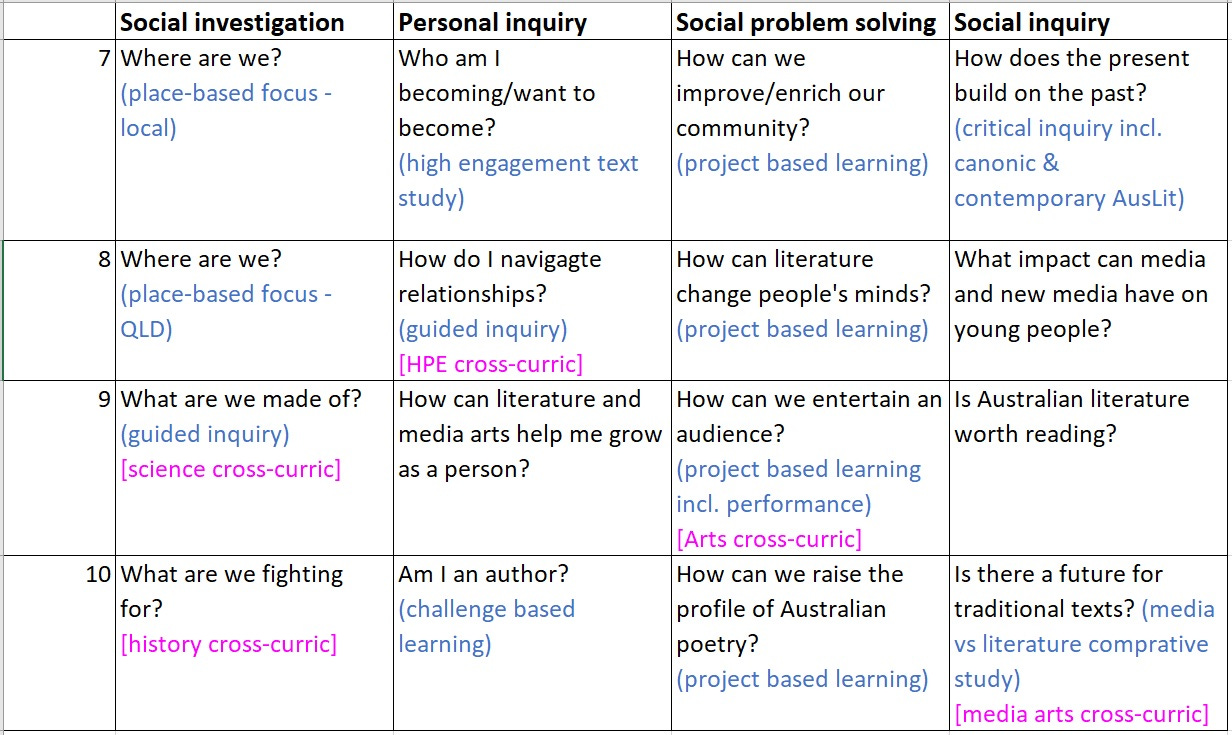
My design principles were:
Aim each year for students to experience a ‘social’ inquiry, as well as a ‘personal’ inquiry, to avoid all the inquiries being issues-based.
Provide strong and clear opportunities for reading and writing sustained literature each year.
Include some cross-curriculum links, without going overboard and exhausting everyone.
Make the connection between ‘problem solving’ and ‘project based learning’ clear by indicating a real world problem.
Provide explicit opportunities to think about Australian literature and its importance in Australian society and culture.
Provide explicit opportunities to think about media texts and our changing text-context landscape.
If you are an English teacher or Head of Department, some points of reflection…
Does your current junior program frame text studies as inquiry-based, or content-based learning?
How often do students in your program get to publish for a public audience?
What logic or design principles (other than the Australian curriculum) currently underpins your program design?
What pedagogic patterns and intentions would your junior program ‘mud-map’ reveal?
And a final invitation:
What would you change or add to my imagined program? What questions do you have, or what is it missing?